

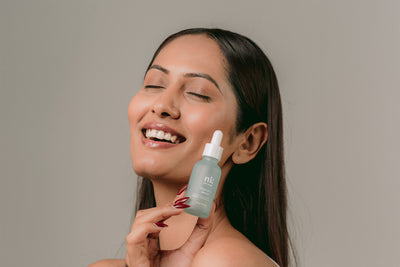
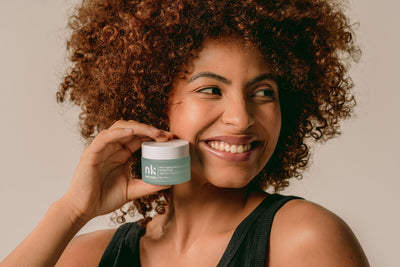
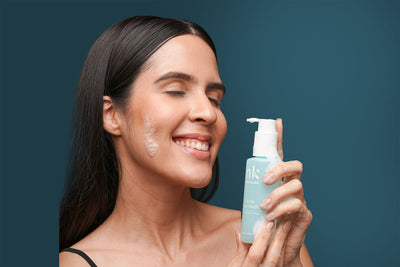
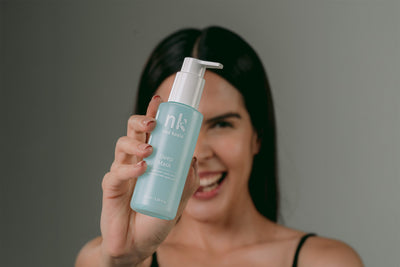
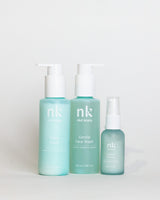
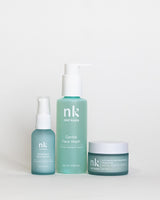
The four skin types you see on every product (normal, dry, oily, combination) are a retail classification, not a biological one. Real skin varies by season, climate, hormone cycle, age, medication and what you used on it last week. Choosing products by concern and by what your skin is doing right now works better than choosing by type.
Where did the four skin types come from?
The normal/dry/oily/combination framework was popularised by the cosmetics industry as a way to sort customers into product lines. It was a merchandising tool. It was a good one, and it is still in use today, but it was never a description of how skin actually behaves.
Dermatology has its own classifications, and they measure different things. The Fitzpatrick scale, developed in the 1970s, describes how skin responds to ultraviolet light. It says nothing about whether you need a richer moisturiser. The two systems get conflated constantly in beauty marketing, usually to nobody's benefit.
Why do the skin type categories break down?
Consider a single person over one year in Melbourne.
In February their skin is oilier, they sweat more, they break out along the jaw. In July, with the heater running, the same skin is tight after cleansing and flakes around the nose. Their T-zone is shinier than their cheeks year-round. They started a new medication in April and everything changed for six weeks.
Which of the four boxes is that? All of them, in sequence. The classification cannot hold the thing it claims to describe.
Then there is the confusion the categories actively create. Dry and dehydrated get used interchangeably and mean different things: dry skin lacks oil and is a type; dehydrated skin lacks water and is a temporary condition anyone can have, including very oily skin. Someone with oily, dehydrated skin who follows the "oily" aisle ends up stripping their face with products designed to remove the oil they need, which is exactly how skin ends up producing more of it.
What do koalas have to do with it?
Koalas have fingerprints. Not something fingerprint-like. Actual dermatoglyphs, with the same loops and whorls as ours, close enough in pattern that University of Adelaide researchers described it as fingerprint homoplasy in 1997, though a trained examiner can still tell the two apart. It is genuinely strange, because koalas and humans have been on separate evolutionary paths for well over a hundred million years. Read more in Do koalas really have fingerprints like humans?
Two lineages, separated by that much time, arrived independently at the same solution. The likeliest explanation is grip: koalas spend their lives handling eucalyptus leaves and branches, and ridged skin grips better and reads texture better. Convergent evolution, not shared ancestry.
We took the name from it, and we took the idea from it too. A fingerprint is the standard example of something individual: no two are identical, including between identical twins, including on your own two hands. Skin is the same kind of thing. It is not that everyone's skin is unique in some vague inspirational sense; it is that the specific combination of what your skin does, when, and in response to what, is yours.
What should you ask instead of "what is my skin type"?
A more useful set of questions:
- What do I actually want to change? Breakouts, dark marks, dryness, texture, fine lines. One or two things, not five. This is the question that should pick your active ingredient.
- How does my skin feel four hours after cleansing? Tight means you need more water, more oil, or a gentler cleanser. Shiny all over means the opposite. Fine means leave it alone.
- What is my skin doing this season? Most people need a lighter routine in summer and a richer one in winter. Running the same routine year-round is a common reason things stop working in April.
- How many steps will I genuinely do? A three-step routine you follow beats a seven-step routine you abandon in week two. This is the least glamorous question on the list and the one that determines whether any of it works.
- What have I reacted to before? If a specific ingredient has stung or flushed your skin, that is real data about your skin specifically, and it is worth more than any category.
How does this shape what NKD Koala makes?
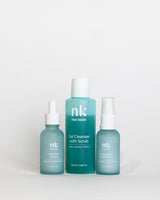
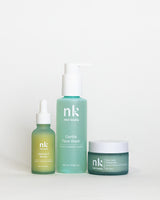
We make ten formulas rather than a hundred, and eight Rituals that combine them. Not one of them is labelled "for oily skin" or "for dry skin", because we do not think that is the useful axis. They are organised by what you are trying to change. Compare all eight skincare Rituals.
Our skin quiz asks five questions along the lines above: your main concern, how your skin feels through the day, your experience with actives, how many steps you will realistically do, and whether you want anything below the neck. It takes about a minute, it tells you which Ritual it matched you to and why, and you can add the whole set or any single formula from it.
It will not tell you your skin type. That is deliberate.
Sources
- Fitzpatrick TB. The validity and practicality of sun-reactive skin types I through VI. Archives of Dermatology, 1988;124(6):869-871.
- Henneberg M, Lambert KM, Leigh CM. Fingerprint homoplasy: koalas and humans. naturalSCIENCE, 1997. University of Adelaide.
This article is general information, not medical advice. If you have a persistent skin concern, speak to a pharmacist, GP or dermatologist.